
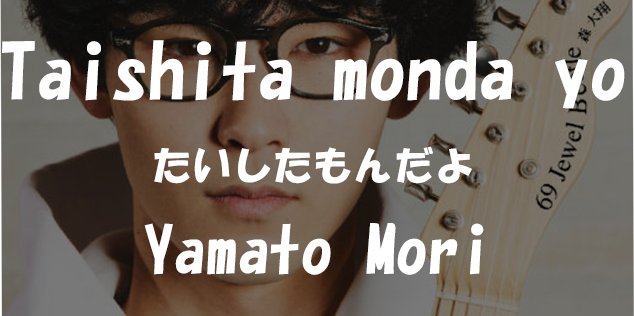
In this article, we explore the lyrics of Yamato Mori’s “Taishita Monda yo” (たいしたもんだよ), tracing its imagery, recurring motifs, and the emotional journey from hesitation to affirmation. Rather than focusing on production, we examine how symbols such as sunset, crossroads, signals, and sky shape the narrative. By the end, you may find yourself returning to the song with a renewed perspective.
Background of the Song
Released on May 31, 2023, “Taishita Monda yo” appeared on Mori’s debut album 69 Jewel Beetle. Written, composed, and arranged entirely by Mori, the track marked a turning point in his career: from being recognized as Young Guitarist of the Year 2019 to stepping forward as a songwriter who dares to articulate vulnerability.
The music video, directed by Yuta Yoshii, features model Serin and frames Mori’s confession as a generational story of doubt and renewal.
Reading the Lyrics
The opening lines immediately set a vivid scene:
「夕焼け 交差点 ひとり
https://www.google.com/url?q=https://www.uta-net.com/song/338055/&sa=D&source=editors&ust=1757777385439296&usg=AOvVaw2PBRmwoyGLCLmMmrcYox1y
行きたい場所 なりたい形も浮かばない
自分自信 疑心暗鬼で不安定」
(“Sunset, at the intersection alone / No destination, no shape I want to become / My own self, unstable with doubts and suspicion”)
The sunset establishes the tone of quiet melancholy, casting the crossroads as both literal and symbolic. Twilight is liminal—a time between day and night, certainty and uncertainty. To be alone in that moment is to stand at life’s threshold, directionless and fragile.
Later, Mori introduces the refrain that anchors the song:
「“たいしたもんだよ” と自分に言ってみる
https://www.google.com/url?q=https://www.uta-net.com/song/338055/&sa=D&source=editors&ust=1757777385439296&usg=AOvVaw2PBRmwoyGLCLmMmrcYox1y
“大丈夫” に自分を隠して」
(“I try telling myself, ‘you’ve done well enough’ / I hide behind the words ‘I’m fine’”)
The irony of telling oneself taishita mon da yo (“you’ve done well enough”) sits alongside the concealment of vulnerability. Together, these lines portray the paradox of modern resilience: strength often masks fragility. What begins as sarcasm gradually shifts into a mantra of survival.
Toward the end, the lyrics turn toward renewal:
「この広い空の下で果てしなく小さくなって
https://www.google.com/url?q=https://www.uta-net.com/song/338055/&sa=D&source=editors&ust=1757777385439296&usg=AOvVaw2PBRmwoyGLCLmMmrcYox1y
それならさ 少し心は軽くなった
今信号は青に変わったよ」
(“Under this vast sky, shrinking endlessly small / If that’s the case, my heart feels a little lighter / Now the signal has turned blue”)
Here, solitude in the “vast sky” paradoxically brings relief, reframing smallness as freedom. The traffic signal—once blinking red, a metaphor of paralysis—finally changes to blue, symbolizing permission to step forward. The song closes with repeated self-affirmation, no longer ironic but genuine.
Symbolic Motifs
- Sunset: marks hesitation at the threshold between day and night, hope and despair.
- Intersection: the place of indecision, where one feels isolated from others.
- Traffic Signals: shifting from red (hesitation) to blue (movement, hope).
- Sky: a vast backdrop for tears, yet also a space of release and perspective.
- Refrain “たいしたもんだよ”: ironic at first, but transformed into affirmation through repetition.
Musical Architecture
Mori describes himself as having a “fear of repetition”, avoiding the conventional J-pop cycle of chorus loops. “Taishita Monda yo” unfolds narratively instead, aligning form with lyrical storytelling.
Musically, the track begins with acoustic intimacy, adds rhythmic complexity, and culminates in a soaring guitar solo—a passage Mori insisted was necessary to “complete the song”. Critics praised the structure as kaleidoscopic, its constant motion mirroring the lyrical journey.
Visual Storytelling: The MV
The MV extends the song’s imagery with expansive skies and roads that stretch toward unseen horizons.
Serin plays a figure who mirrors Mori’s inner conflict, embodying the universality of doubt and renewal. Directed by Yuta Yoshii, the MV feels less like a promo clip and more like a short film, complementing the song’s emotional depth.
Reception and Critical Response
In his 3rd Tour “Let It Grow”, Mori closed with “Taishita Monda yo”, performing as if to “stand the audience up with him”. Fans responded by echoing the refrain, turning solitary self-talk into communal affirmation.
Critics echoed this sentiment. Rockin’On Japan emphasized that Mori’s artistry lies not in hiding fragility but in transforming it into universality. Other outlets praised the song as a “generational anthem of resilience”.
Conclusion
“Taishita Monda yo” crystallizes the dual essence of Yamato Mori: virtuoso guitarist and vulnerable songwriter. The refrain “たいしたもんだよ” bridges irony and encouragement, private struggle and collective hope.
It tells us that even in tears beneath the sunset sky, even in hesitation at life’s crossroads, survival itself is remarkable. And perhaps that reminder—that living is already “taishita mon da yo”—is the song’s quiet gift to its listeners.
Uta-Net: “Taishita Monda yo” Lyrics by Yamato Mori
https://www.uta-net.com/song/338055/
BARKS: Yamato Mori releases MV for new song “Taishita Monda yo”
https://barks.jp/news/972550/
CDJournal: MV release from Yamato Mori’s debut album featuring “Taishita Monda yo”
https://www.cdjournal.com/main/news/news.php?nno=104127
ROCKIN’ON JAPAN: First Interview with Yamato Mori in JAPAN
https://rockinon.com/blog/japan/206411
Guitar Magazine: Interview with Yamato Mori (July 14, 2023)
https://guitarmagazine.jp/interview/2023-0714-yamato-mori/
USEN: Yamato Mori 3rd Tour “Let It Grow” Tokyo Performance Report
https://e.usen.com/news/news-event/-3rd-tourlet-it-grow.html


Comments