
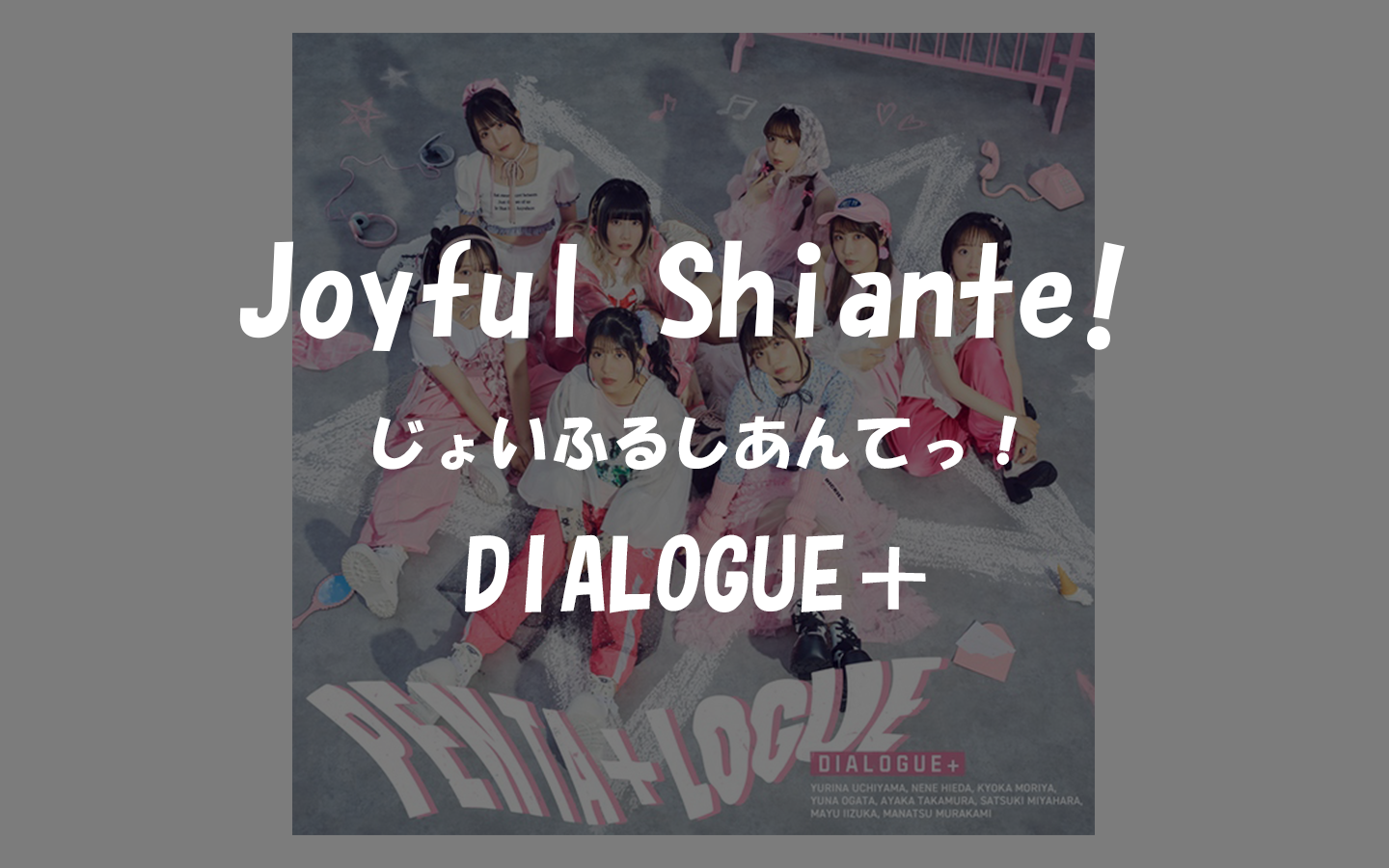
Voice actress unit DIALOGUE+ has always stood at the intersection of story and sound. Produced by Tomoya Tabuchi (UNISON SQUARE GARDEN), the group debuted in 2019 and has since released 13 singles, all tied to anime. In 2024, they released Joyful Shiante! (じょいふるしあんてっ!) as part of the ambitious EP PENTA+LOGUE.
This track is more than just an uptempo pop anthem. With a title blending humor and philosophy, hyper-dense lyrics, and a genre-defying sound, it has become a turning point in the group’s identity. In this article, we’ll explore the lyrics meaning and analysis, unpacking its references, themes, and the unique “dialogue” it creates with fans.
Song Overview
- Title: じょいふるしあんてっ! (Joyful Shiante!)
- Artist: DIALOGUE+


- Release: September 14, 2025 (first performed at DIALOGUE+ THE MOVIE)
- Songwriters: Tomoya Tabuchi (lyrics, composition), R・O・N (arrangement)
- EP: PENTA+LOGUE (five tracks by five creators)
- Genre: Hybrid of J-pop, rock, EDM, and anisong
- Theme: Living in the present, embracing mistakes, and celebrating originality
Lyrics Breakdown
Intro / Opening Lines
Japanese: テクマクマヤコン準備万端 カフカも腰抜かしちゃうスポットライト
https://j-lyric.net/artist/a0608b9/l065e51.html
Romaji: Tekumakumayakon junbi bantan, Kafuka mo koshi nukashichau supottoraito
English: Magic spell—everything’s ready, even Kafka would be shocked by this spotlight.
The lyrics launch with surreal, rapid-fire imagery, setting the pace for what Tabuchi himself calls “maximum dialogue speed.” The wordplay mirrors the group’s identity: conversation pushed to its limits.
Verse 1 – Chaos and Creativity
Japanese: 不可能を可能にしよう って言うより誰もやってそうにないからチャンスじゃん
https://j-lyric.net/artist/a0608b9/l065e51.html
Romaji: Fukanou wo kanou ni shiyou tte iu yori dare mo yattesou ni nai kara chansu jan
English: Rather than saying “let’s make the impossible possible,” it’s a chance because no one else is doing it.
The verse frames challenge as opportunity. Instead of repeating clichés, the group insists on originality—doing what no one else dares to attempt.
Pre-Chorus – Vulnerability in Playfulness
Japanese: すごくない? そんでまた会いたくなるでしょ?
https://j-lyric.net/artist/a0608b9/l065e51.html
Romaji: Sugokunai? Sonde mata aitaku naru desho?
English: Isn’t it amazing? And it makes you want to see us again, right?
The tone becomes playful, almost teasing. Yet within the banter lies a subtle admission: the desire to be seen, remembered, and connected with listeners.
Chorus – Beyond Joyful
Japanese: ジョイフルジョイフル飛び越してジョイフルシアンテじゃん
https://j-lyric.net/artist/a0608b9/l065e51.html
Romaji: Joyful, joyful tobikoete Joyful Shiante jan
English: Jumping past “joyful, joyful”—this is Joyful Shiante!
The chorus defines the song’s essence. It suggests moving beyond shallow joy (joyful) toward a deeper, transformative happiness symbolized by “Shiante,” a playful nod to John Frusciante. Here, joy isn’t just fleeting—it’s reborn through struggle and renewal.
Verse 2 – Falling and Rising Again
Japanese: ミスしちゃったら落ち込んでもっかい立ち上がれ
https://j-lyric.net/artist/a0608b9/l065e51.html
Romaji: Misu shichattara ochikonde mokkai tachiagare
English: If you make a mistake, get down, then stand up again.
The song embraces mistakes not as shame, but as steps in an endless spiral of growth. Failure is reframed as a positive revolution, echoing the line: “Even if the future isn’t what you hoped for, if you can believe it’s right, that’s your circle of victory.”
Bridge – Originality Over Clichés
Japanese: ありがちキメ台詞よりもっと欲張ってさ煮詰めたオリジナリティ!
https://j-lyric.net/artist/a0608b9/l065e51.html
Romaji: Arigachi kime serifu yori motto yokubatte sa nitsumeta originality!
English: Forget the usual catchphrases—be greedier, refine your own originality!
Here the song openly rejects clichés, celebrating authenticity. It ties directly to the Frusciante metaphor: an artist who fell, rebuilt, and returned stronger through raw self-expression.
Climax / Final Chorus
Japanese: 希望通りの未来じゃなくたってこれが正解だって思えたんならハナマルだから
https://j-lyric.net/artist/a0608b9/l065e51.html
Romaji: Kibou doori no mirai janakutatte kore ga seikai datte omoetan nara hanamaru dakara
English: Even if the future isn’t what you wished for, if you can believe it’s right, that’s a perfect circle.
The climax transforms imperfection into victory. The symbol of the “hanamaru”—a childlike circle stamp given for good work—becomes a mature philosophy of self-acceptance.
Themes & Interpretations
- Living in the Present: “Play now, because life changes depending on what exists and what doesn’t.”
- Embracing Mistakes: Growth is a spiral, not a straight path—failure is fuel for renewal.
- Authenticity Over Templates: Rejecting clichés in favor of originality reflects both the group’s concept and Tabuchi’s songwriting ethos.
- Frusciante Reference: Beyond music, the title honors resilience—the joy found in overcoming hardship.
Connection to Artist’s Life / Previous Works
Producer Tabuchi’s fingerprints are everywhere: hyper-dense syllables, wordplay at breakneck pace, and themes of resilience. Compared to earlier DIALOGUE+ tracks, Joyful Shiante! marks a bolder, genre-crossing step, pushing both lyrical density and philosophical depth.
Connection to Live Performance
First unveiled at DIALOGUE+ THE MOVIE on September 14, 2025, the track was paired with a dramatic reading scripted by Bottom-tier Character Tomozaki author Yuuki Yaku. Later that evening, it exploded on stage at PENTA+LOGUE Prelude, where live band energy, playful choreography, and even mock instrument solos embodied the lyric “We’ll blow you away!”
The song’s philosophy of “living now” was no longer abstract—it became real in the shared heat between performers and audience.
Behind the Lyrics of “Joyful Shiante!” – Q&A Section

What does “Joyful Shiante!” mean?

It blends “Joyful” and “Frusciante,” symbolizing joy beyond fun—joy reborn through resilience.
Is this just a happy anisong?
No. Beneath its playful tone, the song celebrates mistakes, originality, and self-acceptance.
Why mention John Frusciante?
Not for his guitar style, but his philosophy—surviving hardship, rebuilding, and finding true joy in creativity.
Conclusion
DIALOGUE+’s Joyful Shiante! is more than a pop track—it’s a manifesto of imperfection, originality, and resilience. With Tabuchi’s high-speed lyricism, R・O・N’s genre-blending arrangement, and the group’s passionate performance, the song redefines what an anisong can be.
👉 What about you—do you hear Joyful Shiante! as a playful anthem, a life philosophy, or both? Share your interpretation below.

Comments